I was twenty-two, broke, and trying to impress a girl who was definitely out of my league. That’s the classic setup for a kitchen disaster, right? I bought a chuck roast because it was big and cheap. I didn’t know what I was doing. I treated that poor slab of beef like it was a delicate filet mignon. I seared it until it looked good on the outside, threw it in the oven for maybe twenty minutes, and slapped it on a plate.
It was inedible. We’re talking shoe leather. We sat there sawing at the meat for forty-five minutes, making polite conversation while my jaw slowly cramped up. We eventually gave up and ordered a pepperoni pizza. I didn’t get a second date. But I did learn a lesson that stuck with me longer than the embarrassment: you can’t rush cheap meat.
Fast forward a decade. I’m standing in my own kitchen, listening to the rain hit the window, and the house smells like thyme, garlic, and reduced red wine. I pulled the heavy iron pot out of the oven, and the meat just… fell apart. No knife needed. If you are asking yourself, “What is the best way to cook a chuck roast,” you’re asking the right question. It’s not about fancy equipment. It’s about understanding that this tough, stubborn cut of beef needs time to surrender.
More in Beef & Red Meat Category
What is The Best Way to Cook a Rib Roast
What is The Best Way to Cook London Broil
Key Takeaways
- Patience is Your Main Ingredient: You cannot rush this. If you try to speed-cook a chuck roast, you end up with a rubber tire. Low and slow is the law.
- Sear It Like You Mean It: You need a dark, aggressive crust on the meat before any liquid hits the pan. No grey meat allowed.
- The Liquid Balance: You aren’t boiling the meat; you’re bathing it. Use broth and something acidic like wine or vinegar to cut the fat.
- Simmer Down: A rolling boil toughens the protein. You want a lazy bubble, barely moving.
- Let It Rest: Cutting into a hot roast instantly drains the juice. Give it twenty minutes to relax.
Why Do We Gravitate Toward this Tough Cut of Beef?
It’s a fair question. Why buy a piece of meat that requires three hours of babysitting? Chuck roast comes from the cow’s shoulder. That animal walked around on these muscles all day long. They are tough. They are dense. They are loaded with connective tissue called collagen.
If you throw this on a grill, that collagen tightens up and squeezes all the moisture out. It’s terrible.
But here is the secret.
When you cook that same tough collagen slowly, at a low temperature, it melts. It physically transforms into gelatin. That’s the sticky, lip-smacking goodness you get in a good pot roast. A butcher once told me, pointing his knife at the white marbling, “Don’t fear the fat. That white stuff? That’s your insurance policy against dry meat.” He wasn’t lying. That gelatin coats the muscle fibers, giving you a richness that a lean, expensive steak just can’t match.
Is Braising Really the Superior Method?
Yes. Period.
There are people who will try to tell you to smoke it like a brisket or sous vide it for 48 hours. Those are fine experiments. But if we are talking about the best way to cook a chuck roast, braising is the undisputed king.
Braising is just a fancy word for “searing it hard and then cooking it halfway covered in liquid.”
I tried to roast one dry once, thinking I could treat it like prime rib. Big mistake. It came out dry, stringy, and sad. The magic of braising is the humidity. The lid on your pot traps the moisture. This creates a steam environment that gently breaks down that collagen we talked about, while the liquid transfers heat into the center of the meat. Plus, at the end of the day, you have a pot full of liquid gold that puts any store-bought gravy to shame.
Does the Pot You Use Actually Make a Difference?
I have a heavy, enameled Dutch oven that I bought at a garage sale for twenty bucks. It’s chipped, stained, and weighs a ton. It is the single most important tool in my arsenal.
You need something heavy. Thin metal pans fluctuate in temperature every time your oven cycles on and off. Cast iron holds the heat. It hugs the meat in a steady, constant warmth.
- The Dutch Oven: The heavyweight champ. You can sear on the stovetop and transfer it straight to the oven. It keeps all those browned bits—the “fond”—right in the dish.
- The Slow Cooker: Look, I get it. It’s easy. But you usually can’t sear in it. If you throw raw meat into a slow cooker, you get gray, boiled beef. It’s edible, sure, but it’s not great.
- The Instant Pot: It’s fast. It works. But I find the texture gets a little weird. It shreds too fine, almost like pulled pork, rather than holding that nice sliceable structure.
If you have the time, use the heavy pot. The radiant heat from the heavy lid cooks the beef from the top down, browning the exposed parts while the submerged parts get tender.
How Do You Build Deep Flavor Before the Roast Hits the Oven?
My dad was a “salt and pepper” guy. And honestly, for a good steak, that’s fine. But a chuck roast is a thick, dense block of muscle. You need to season it aggressively.
I coat the meat in kosher salt and coarse black pepper until I can barely see the red anymore. It looks like too much. It isn’t. That salt has to penetrate inches of meat.
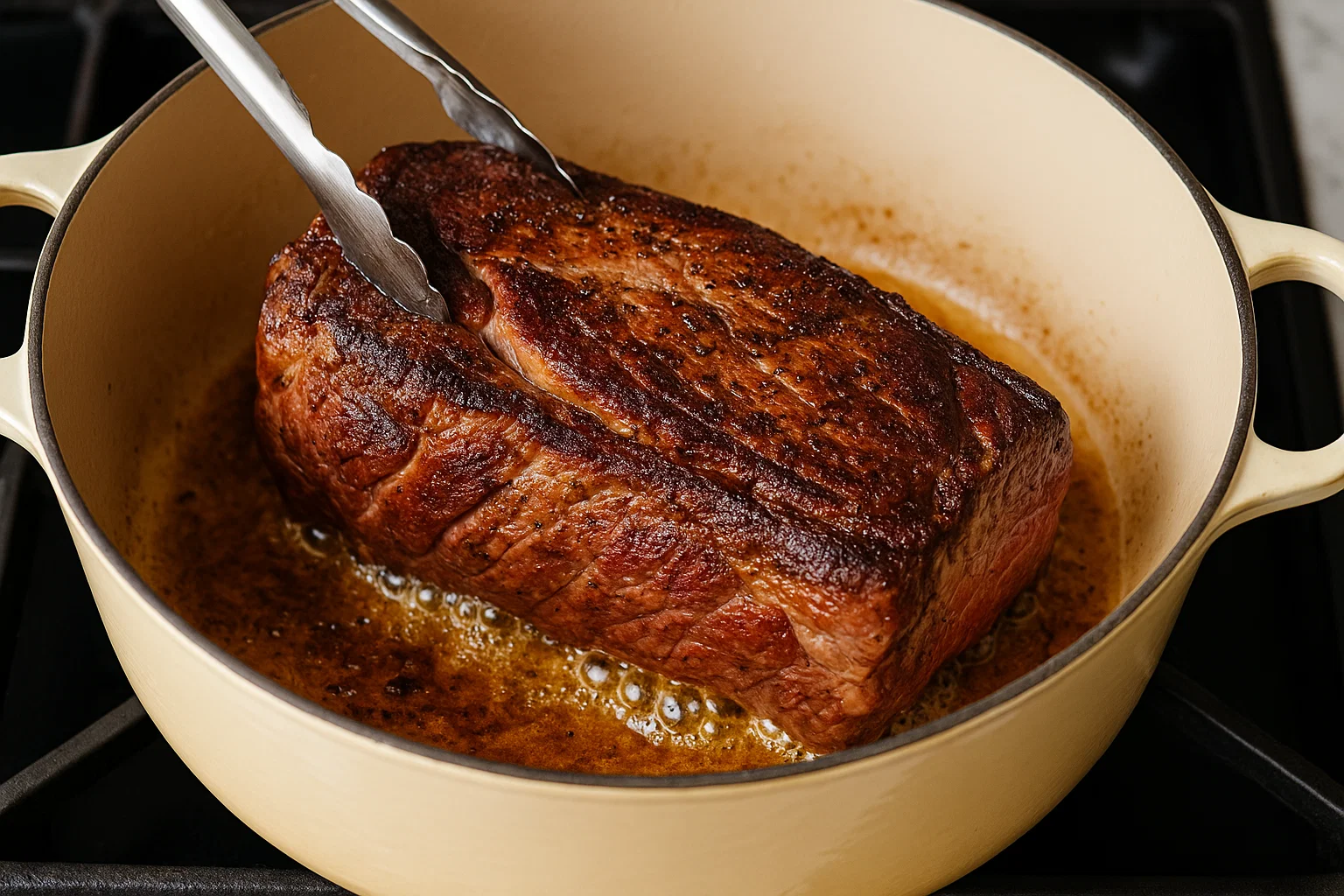
Then, the sear. This is where most home cooks mess up. They get the pan “kind of” hot. No. You want that oil shimmering and almost smoking. When the meat hits the pan, it should sound like a jet engine taking off.
Don’t touch it.
Seriously, leave it alone. Let it sit there for five, maybe six minutes. You want a crust that looks dangerously close to burnt. That’s the Maillard reaction. That’s where the savory, “meaty” flavor comes from. If you just brown it until it’s tan, you’re leaving 50% of the flavor on the table.
Should You Deglaze with Red Wine or Stock?
So you’ve pulled the meat out. It’s resting on a plate. Look at the bottom of your pot. It’s covered in dark, sticky brown stuff. Do not scrub that out. That is pure flavor concentrate.
I almost always grab a bottle of dry red wine. Cabernet, Merlot, Syrah—something big and bold. You pour a cup of that into the hot pot, and it boils instantly. The steam hits you in the face, smelling like grapes and beef. Use a wooden spoon to scrape up all those brown bits.
The wine does two things. One, it adds a complex, fruity depth. Two, the acidity cuts through the fat. Chuck roast is fatty. If you don’t have acid, the dish feels heavy on your tongue. If you don’t do alcohol, use beef broth with a heavy splash of balsamic vinegar or even apple cider vinegar. You need that sharp bite to balance the richness.
What is The Best Way to Cook a Chuck Roast for Fall-Apart Tenderness?
Here is the drill. Meat goes back in the pot. Aromatics go in. Liquid goes halfway up the side of the meat. Lid goes on.
Oven temperature matters. I stick to 300°F (150°C).
A lot of old recipes say 350°F. I think that’s too hot. You don’t want the liquid inside the pot to be boiling violently. You want a lazy simmer. A gentle bubble. If you boil the meat, the muscle fibers seize up and squeeze out their juice. You end up with dry meat in a wet sauce.
How long? It usually takes about 3 to 4 hours for a standard 3-pound roast. But stop looking at the clock. The clock lies. The meat tells the truth.
I use the “fork test.” Stick a fork into the thickest part of the meat and try to lift it. If the meat lifts with the fork, it’s not done. If the fork slides out like you stuck it in a stick of room-temperature butter, you are golden.
Can You Actually Overcook a Pot Roast?
Yes. There is a myth that you can just leave a pot roast in the oven all day.
If you cook it too long, the fibers break down completely. The structure collapses. You end up with something that has the texture of wet sawdust. It’s mushy, yet somehow dry when you chew it.
You want to catch it right at that moment where it yields to the fork but still holds its shape when you slice it. I start checking mine at the 2.5-hour mark, just to see where we are at. It’s better to check three times than to accidentally let it turn to soup.
Which Vegetables Stand Up to the Long Haul?
My grandmother made a great roast, but her carrots were always sad. They were gray, mushy little tubes that disintegrated if you looked at them wrong. That’s because she put them in at the start.
Carrots and potatoes do not need four hours to cook.
I put my onions, garlic, and celery in at the beginning. They are there for flavor. They will basically melt into the sauce, and that’s fine. But the “eating vegetables”—the big chunks of carrots and potatoes—I throw those in for the last 45 minutes to an hour.
This way, the potatoes are tender but not falling apart. The carrots still have a little bit of resistance when you bite them. They actually taste like vegetables, not like beef-flavored baby food.
For potatoes, go with Yukon Golds. They are waxy and hold their shape. Russets are for baking; if you put them in a stew, they dissolve and make the sauce gritty.
How Do You Fix a Dry Roast if You Mess Up?
Okay, let’s say you messed up. The kids were screaming, the game went into overtime, and you forgot the roast. You pull it out, and it feels tight.
Don’t panic. You can cheat a little.
Slice the meat against the grain. This is crucial. It physically shortens the muscle fibers so you don’t have to chew as much. Then, put those slices back into the pot with the liquid. Put the pot on the stove on low heat. Let the meat sit in that juice for twenty minutes.
It’s like a soak. The meat will absorb some of that liquid back into its dried-out fibers. It won’t be perfect—you can’t un-cook it—but it will save dinner. Serve it with plenty of gravy, and nobody will complain.
What About the Aromatics?
I don’t like fishing dried rosemary needles out of my teeth.
I tie my herbs together. I get a bunch of fresh thyme, a few sprigs of rosemary, and a bay leaf, and I tie them up with a piece of butcher’s twine. I toss that little bundle into the pot. When the roast is done, I just fish out the bundle and toss it.
Fresh herbs are better here. Dried herbs tend to get lost or turn bitter over a 3-hour cook. Fresh thyme has this woodsy, floral thing going on that just works with beef fat.
I also throw in a whole head of garlic. I just slice the top off the bulb and drop it in, skin and all. Later, the cloves squeeze out like roasted garlic paste. It’s incredible.
Should You Sear the Vegetables Too?
You don’t have to. But if you want to take it to the next level? Yes.
After I take the beef out, and before I add the wine, I toss my carrots and onions into that hot beef fat. I let them get a little brown on the edges.
This caramelizes the sugars in the veg. It adds a sweetness that balances the savory beef. If you just boil raw carrots, they taste one-dimensional. Roasting them in the beef fat for five minutes wakes them up. It’s one extra step, but I think it’s worth the dirty spoon.
What is the Role of Resting?
This is the hardest part. You’ve been smelling this roast for three hours. Your stomach is growling. You take it out of the oven, and you just want to hack into it.
Stop.
The juices inside that meat are boiling hot and moving fast. If you cut it now, they run out all over your cutting board. You’ll watch the flavor drain away.
Tent the pot with foil. Walk away. Go set the table. Pour a drink. Give it 20 to 30 minutes. As the meat cools slightly, the juices thicken and redistribute. The meat relaxes. When you finally slice it, the juice stays in the slice.
How Do You Turn the Liquid into Gravy?
You have a pot full of thin, dark liquid. It tastes amazing, but it runs all over the plate. I like a gravy that sticks to my potatoes.
I strain the liquid into a saucepan. I skim off some of the fat floating on top (save that fat for roasting potatoes tomorrow, trust me). Then I bring the liquid to a simmer.
I mix a tablespoon of cornstarch with a splash of cold water in a cup until it’s smooth, then whisk that into the boiling liquid. It thickens up instantly. Taste it. This is your moment. Does it need salt? pepper? Maybe a dash of soy sauce for color? Make it perfect before you pour it over the meat.
What Can You Do With the Leftovers?
I’m going to be honest: I almost prefer the leftovers.
The next day, the flavors have melded. The garlic has gotten to know the thyme. The beef has soaked up even more juice.
My go-to move is the “Debris Po-Boy.” I take the cold beef and the gravy, heat it up in a skillet until it’s bubbling, and pile it onto a toasted French baguette. Add some mayo, maybe some pickles. It is messy. It runs down your arm. It is absolutely glorious.
Or, chop it up and make a hash. Fry some diced potatoes in a skillet, toss in the chopped beef and carrots, let it get crispy, and throw a fried egg on top. Breakfast of champions.
Why Does This Meal Bring People Together?
There is something ancient about cooking a large piece of meat in a heavy pot. It’s primal. It signals to everyone in the house that they are going to be taken care of.
I remember coming home from college for Christmas break. I was tired, stressed, and sick of cafeteria food. I walked in the door, and the smell of my mom’s pot roast hit me like a physical hug. I knew, right then, that I was home. I was safe.
You can’t make a pot roast for one person. It’s too much food. It is a meal that demands to be shared. It requires you to plan ahead, to start cooking at 2 PM for a 6 PM dinner. That effort shows people you care.
Final Thoughts on Mastering the Chuck
If you are still wondering “What is the best way to cook a chuck roast,” just remember that disastrous date I had at twenty-two.
Don’t be that guy. Don’t rush it.
We live in a world where everything is instant. You can stream any movie in seconds. You can order dinner with a thumbprint. But you cannot download a pot roast.
You have to earn it. You have to participate in the process. You have to listen to the sizzle of the sear, smell the wine reducing, and feel the resistance of the meat against the fork.
So go buy a big, ugly chuck roast. Get a bottle of wine you actually like drinking. clear your Sunday schedule. Put on some blues or jazz. Take your time.
When you finally sit down and take that first bite of tender, savory beef, you’ll realize that the time wasn’t wasted. It was the secret ingredient all along.
If you want to geek out on exactly why that collagen turns into gelatin, check out this breakdown on The Science of Slow Cooking. It explains the chemistry behind the magic.
Now, go get that heavy pot out of the cupboard. You’ve got dinner to make.
FAQs – What is The Best Way to Cook a Chuck Roast
What is the most effective method to cook a chuck roast for optimal tenderness?
The most effective method to cook a chuck roast for optimal tenderness is slow braising at a low temperature, around 300°F, for about 3 to 4 hours, ensuring the collagen melts into gelatin and the meat becomes fall-apart tender.
Why is braising considered the superior way to cook a chuck roast?
Braising is considered the best method because it involves searing the meat and cooking it in humid, liquid environment which breaks down the connective tissue and results in tender, flavorful meat, unlike dry roasting which can make the meat dry and stringy.
Does the type of pot matter when cooking a chuck roast?
Yes, using a heavy, enameled Dutch oven or cast iron pot is ideal because it retains and distributes heat evenly, allowing the meat to cook thoroughly and develop flavor through browning, which thinner or lighter cookware cannot provide as effectively.
How can I build deep flavor before placing the roast in the oven?
You should season the roast heavily with kosher salt and coarse black pepper, then sear it in shimmering hot oil to create a Maillard reaction that develops savory flavors, and deglaze the pan with red wine or broth to incorporate rich, complex tastes.
What is the importance of resting the roast after cooking?
Resting the roast for 20 to 30 minutes after cooking allows the juices to redistribute within the meat, preventing them from spilling out and ensuring the meat remains moist and tender when sliced.