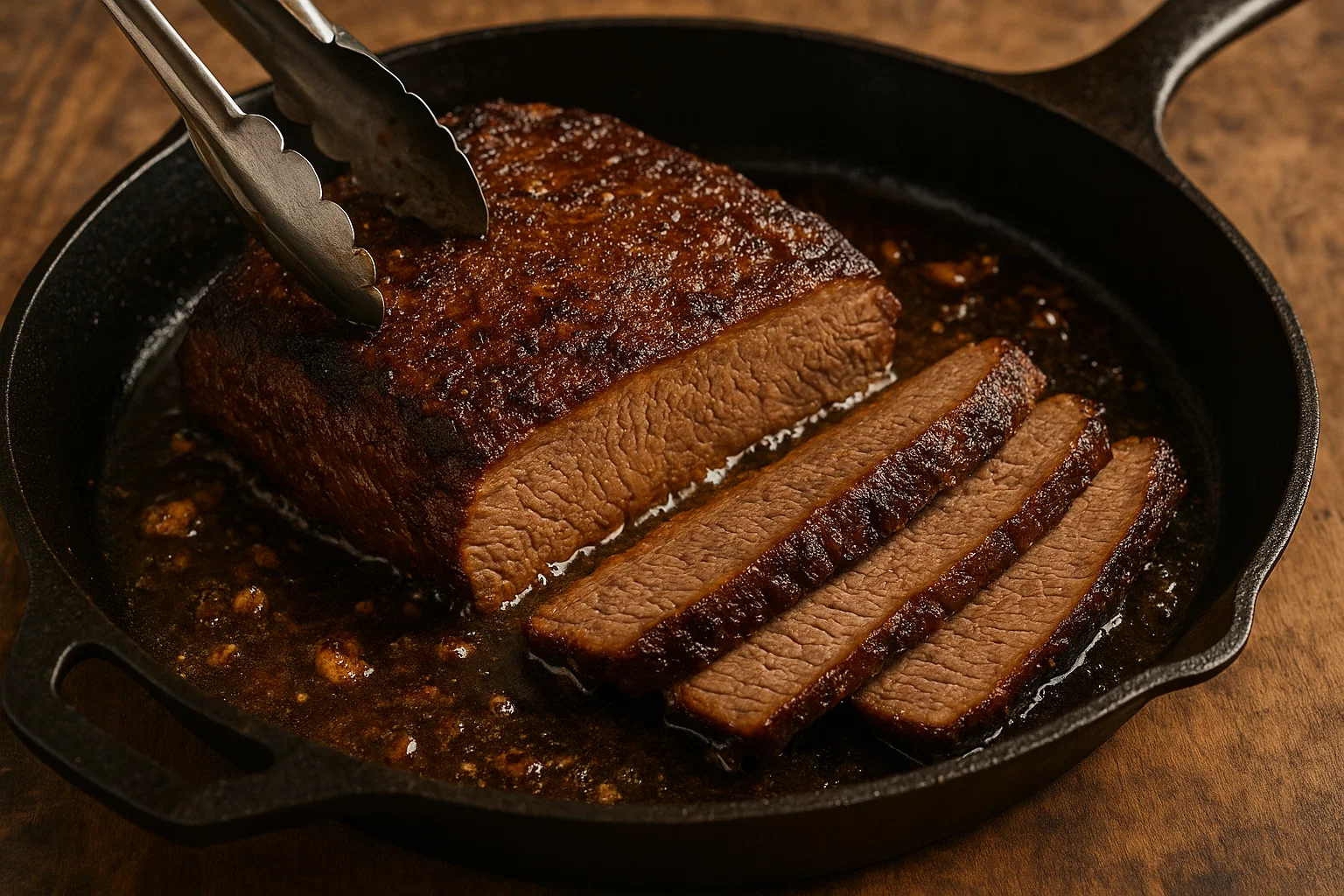
There is a very specific, cold sweat that breaks out on your forehead when you stand at the butcher counter and stare down a full packer brisket. You watch the butcher heave that massive, wobbling slab of beef onto the scale. You watch the price ticker climb—sixty, seventy, maybe eighty dollars depending on the market. You realize you are about to buy twelve pounds of pure potential, but you also know the risk. You are one bad decision away from turning that investment into a dry, inedible doorstop.
If you have found yourself staring at that vacuum-sealed bag wondering what is the best way to cook beef brisket, you aren’t just looking for a recipe. You are looking for insurance. You want to know that when you slice into that meat twelve hours from now, you won’t have to order pizza for your guests in shame.
I’ve been there. My first attempt was a disaster that my family still politely refuses to mention. I walked into the process with unearned confidence and walked out with a piece of meat so tough I could have resoled my work boots with it. It was dry, grey, and an absolute insult to the cow it came from. That failure sparked an obsession. I’ve spent years since then obsessing over fire management, airflow, and the specific humidity inside a Dutch oven. I’ve cooked them in blinding rainstorms, and I’ve cooked them while sleeping soundly in my bed.
The battle between the smoker and the oven isn’t just about heat sources. It’s a philosophical divide. It comes down to what you value more: the primal glory of fire and smoke, or the sane reliability of modern appliances.
More in Beef & Red Meat Category
What is The Best Way to Cook a Rib Roast
What is The Best Way to Cook London Broil
Key Takeaways
- The Texture Distinction: Smoking creates a firm, steak-like slice with a heavy bark, whereas the oven excels at producing fork-tender, shredded meat that melts in your mouth.
- The Lifestyle Cost: A smoker demands your constant attention and likely a sleepless night; the oven asks for nothing but patience.
- Flavor Profiles: Wood fire deposits a unique, chemical flavor ring that cannot be faked, while the oven allows for deep, savory braises with wine and aromatics.
- The Universal Stall: No matter where you cook it, the meat will hit a temperature wall around 160°F where evaporation cools the meat as fast as the fire heats it.
- The Verdict: The “best” method is entirely dependent on whether you want an authentic BBQ experience or a rich, comforting pot-roast style meal.
Why Is Brisket Such a Difficult Beast to Tame?
To understand why this cut scares people, you have to look at the animal. The brisket is the pectoral muscle of the steer. Consider what that animal does all day. It stands. It walks. It pushes itself up from the ground. This muscle supports roughly 60% of the animal’s standing weight. It never stops working.
Because this muscle pulls a double shift every day of the cow’s life, it is reinforced with a massive amount of connective tissue, specifically collagen. This isn’t a ribeye that you can sear for three minutes and serve rare. If you treat brisket like a steak, you will fail. The collagen fibers are like steel cables. They need to be coaxed into submission.
The entire goal of cooking brisket—regardless of the heat source—is to keep the meat in a specific temperature window long enough for that collagen to dissolve into gelatin. That gelatin is the secret. It’s the sticky, lip-smacking substance that coats your mouth and tricks your brain into thinking the meat is juicy, even after the water weight has evaporated. Achieving this alchemy takes time, and it takes trust.
Does the Oven Actually Stand a Chance Against a Smoker?
If you ask this question in certain parts of Central Texas, you might get chased out of town. There is a rigid dogma in the BBQ world that says brisket must be smoked. For a long time, I believed it. I thought that using an oven was cheating. I thought that if I didn’t smell like a campfire for three days, I hadn’t actually cooked anything.
But let’s strip away the ego and look at the thermodynamics. The oven offers a controlled, hermetically sealed environment that a smoker can only dream of.
I remember a specific Thanksgiving a few years back. I had promised brisket. I had a stick burner smoker in the driveway and a pile of oak logs ready to go. Then the temperature dropped to 20 degrees and the wind picked up to 30 mph. I fought that fire for two hours, watching my thermometer swing wildly. I finally swallowed my pride, wrapped the meat, and moved it indoors to the oven.
The result surprised me. It didn’t have the smoke ring. It didn’t have the heavy smoke flavor. But the texture? It was perfect. The oven provides a consistency that removes variables. You don’t have to worry about wind direction, humidity, or wet wood. You set a dial to 225°F, and the machine holds it there. For a home cook with a job, kids, and a need for sleep, the oven is a weapon of mass efficiency.
What is the True Cost of the “Authentic” Smoked Method?
Smoking meat is romantic until it’s 3:30 AM on a Tuesday.
When you commit to the smoker, you are chasing the “bark.” Bark is that dark, meteoric crust that forms on the surface of the meat. It’s the result of the Maillard reaction mixing with spices and smoke. Inside a smoker, the airflow moves constantly across the meat, drying the surface just enough to create this crunch while the low heat breaks down the interior.
You are also chasing the smoke ring. This is that pink halo just under the crust. It happens when nitric oxide from the burning wood absorbs into the meat. Meat science researchers will tell you that the ring doesn’t actually add flavor, but we eat with our eyes. A grey brisket looks sad. A brisket with a vibrant red ring looks like a victory lap.
But the cost is physical. I have distinct memories of the “graveyard shift.” You wake up every hour to check the fire. You smell like soot. You are constantly tweaking vents. It is an active lifestyle choice. You have to ask yourself if you want a project or just dinner.
How Does Braising Change the Equation entirely?
This is where the oven takes a sharp left turn away from “BBQ” and enters the realm of “Comfort Food.”
When I cook brisket in the oven, I almost never roast it dry on a rack. I braise it. I grab my biggest Dutch oven or a deep roasting pan. I lay down a bed of onions, smashed garlic cloves, carrots, and celery. I sear the meat, drop it in, and pour in liquid—usually a mix of beef stock and red wine, maybe a stout beer if I’m feeling adventurous.
Braising changes the physics. The steam trapped inside the heavy lid attacks the connective tissue much faster than dry heat. The meat doesn’t just slice; it shreds. It pulls apart.
I had a revelation about this style of cooking at a friend’s Passover dinner. Her mother served a brisket that had been simmering in a tomato and onion reduction for six hours. It wasn’t “cool” BBQ. It didn’t have a bark. But the flavor was explosive. The acidity of the tomatoes cut through the heavy beef fat in a way that smoke never could. It taught me that “best” is subjective. If you want a sauce-heavy, savory meal that makes its own gravy, the smoker can’t compete.
What Is the “Stall” and Why Does It Make You Panic?
Whether you are burning oak logs or natural gas, you will eventually hit the wall. We call it The Stall.
It usually happens when the internal temperature of the meat hits somewhere between 160°F and 165°F. You have been cruising along, feeling good, watching the numbers climb. Then, everything stops. The temperature might sit there for two hours. It might even drop a degree.
The first time this happened to me, I panicked. I cranked the heat up to 350°F. That was a fatal error.
The stall happens because the meat is sweating. Moisture is evaporating from the surface of the brisket, cooling it down at the exact same rate the fire is trying to heat it up. It is an equilibrium.
- In the Smoker: You have a decision to make. You can wait it out (which builds better bark but takes hours longer), or you can use the “Texas Crutch.” This means wrapping the meat tightly in pink butcher paper or aluminum foil. This stops the evaporation, breaks the stall, and speeds up the cook.
- In the Oven: If you are braising, the stall is less aggressive because the humidity is already at 100%. If you are dry roasting, you will hit the same plateau.
The lesson is patience. If you try to rush the stall with high heat, you will squeeze every ounce of moisture out of the muscle fibers. You will end up with dry meat. You have to trust the process.
How Do the Flavor Profiles Actually Compare?
Here is where the fork in the road becomes a canyon.
The flavor of a smoked brisket is simple, elemental, and aggressive. It tastes of beef, black pepper, salt, and combustion. The wood choice matters immensely. Oak gives a mild, reliable smoke. Hickory punches you in the face. Mesquite can turn bitter if you aren’t careful. The fat renders, drips onto the coals, vaporizes, and wafts back up to flavor the meat. It is a closed loop of flavor that relies on the fire itself.
The oven cannot replicate that. I don’t care what the bottle of Liquid Smoke claims; it is not the same. However, the oven allows for a complexity that the smoker rejects.
When you smoke a brisket, you generally stick to a simple rub. If you put fresh herbs or complex sugars in a smoker for 12 hours, they will burn and taste like ash.
In the oven, the rules disappear. You can stud the meat with rosemary. You can rub it with thyme and onion powder. You can bathe it in wine. The “jus” you get at the end of an oven cook is liquid gold. You strain that liquid, reduce it down, and you have a sauce that rivals any French restaurant. In a smoker, those drippings are usually lost to the fire or turn into a greasy sludge in the bottom of the pit.
Which Method Respects Your Sanity?
Let’s be honest about the logistics.
Smoking a brisket is an event. You have to plan it. You have to buy fuel. You have to trim the meat specifically for aerodynamics so the smoke flows over it smoothly. You have to monitor the weather. I once hosted a BBQ where a sudden thunderstorm soaked my wood pile. I spent the next four hours trying to burn wet wood, creating thick, white, acrid smoke that ruined the meat. It tasted like an ashtray.
The oven is your reliable friend. You preheat. You put the meat in. You leave. You can go to the grocery store. You can play with your kids. You can watch a movie. The temperature in your oven doesn’t fluctuate because the wind shifted directions.
If you are looking for the best way to cook beef brisket on a random Tuesday, or even for a stress-free holiday hosting gig, the oven wins. If you want a hobby—something that makes you feel like you conquered nature—you need the smoker.
Can You Fake the Smoke?
This is controversial territory. Purists will hate this section.
You can get close to a BBQ profile in the oven if you are clever. The trick is smoked paprika, ancho chili powder, and high-quality liquid smoke.
I ran an experiment last month. I took a brisket flat (the leaner end), rubbed it with a mix of smoked paprika, brown sugar, and kosher salt. I placed it on a wire rack over a baking sheet to simulate airflow, rather than braising it. I cooked it at 225°F for six hours, then wrapped it in foil.
Did it taste like it came off a legendary pit in Austin? No. It lacked that deep, penetrating smoke flavor. But it was delicious. It had a smoky nuance that satisfied the craving. If you live in a high-rise apartment where open fire is illegal, don’t let anyone tell you that you can’t make good beef. You just have to manage your expectations.
What Should You Look for When Buying the Meat?
Before you even pick your cooking method, you have to survive the butcher shop.
You will see two main options: the “Packer” and the “Flat.”
The Packer is the whole shebang. It includes both muscles—the lean “flat” and the fatty “point”—connected by a thick seam of fat. This is what you want. The point muscle is heavily marbled and protects the leaner flat during the long cook. It is harder to handle because it is huge (usually 12-16 lbs), but it cooks better.
The Flat is often sold separately in supermarkets. It looks nice and uniform, like a rectangular brick of meat. Be careful here. The flat is lean. Without the point attached, it dries out very easily. If you buy just a flat, I almost exclusively recommend the oven braising method. It needs the liquid help. If you try to smoke a small, trimmed flat, you will likely end up with jerky.
The Critical Step Nobody Talks About: The Rest
There is one step that ruins more briskets than any other, and it happens after the cooking is done.
You pull the meat out. It smells incredible. You are starving. You want to cut it immediately.
Do not touch that knife.
If you slice a brisket hot, the internal pressure will force all the liquid out onto your cutting board. You will watch your juicy dinner evaporate in seconds, leaving you with dry meat.
You need to rest the meat. For a big packer brisket, I rest it for a minimum of two hours. Ideally four. I wrap it in towels and throw it in an empty cooler (we call this the “Faux Cambro” method). The meat relaxes. The juices redistribute and thicken. The temperature comes down slowly. This is the difference between good BBQ and great BBQ.
So, What is The Best Way to Cook Beef Brisket for You?
After burning through more money on beef than I care to admit, I have a system.
If I am cooking for a crowd that expects the “event”—people who want paper plates, white bread, pickles, and cold beer—I smoke it. The oven cannot produce the social atmosphere or the specific texture that people associate with a BBQ party. The labor is part of the performance.
However, if I am cooking for a family holiday dinner, I use the oven. A red-wine braised brisket is elegant. It feels richer. It pairs with roasted vegetables and mashed potatoes. Most importantly, it allows me to be present. I’m not running outside to check vents; I’m pouring wine for my guests.
Ultimately, the best way to cook beef brisket is the one that fits your life that day. Don’t let the gatekeepers bully you. If you have the time and the wood, feed the fire. If you have a busy life and a craving for beef, trust the oven. Just don’t skip the rest period.
FAQs – What is The Best Way to Cook Beef Brisket
What are the main differences between smoking and oven cooking for brisket?
Smoking creates a firm, steak-like texture with a heavy bark and a distinctive smoke flavor, while oven cooking produces tender, shredded meat that melts in your mouth and allows for complex, savory flavors with added aromatics.
Why is brisket considered such a difficult cut to cook perfectly?
Brisket is a tough muscle heavily reinforced with collagen, requiring slow cooking within a specific temperature range to break down the connective tissue into gelatin, which creates juicy, flavorful meat.
Can an oven really replace a smoker when cooking brisket?
Yes, an oven can produce excellent brisket results due to its controlled environment, consistent temperature, and lack of external variables, making it a practical alternative, especially when outdoor conditions hinder smoking.
What is the true cost of smoking brisket and what should I consider?
Smoking brisket involves constant attention, active management of fire and vents, and late-night monitoring, which can be physically demanding and time-consuming, making it a labor of love rather than just cooking.
How does braising in the oven change the flavor and texture of brisket?
Braising involves cooking the meat slowly in liquid with aromatics, resulting in shredded, tender meat with rich, complex flavors, especially from the added wine, vegetables, and herbs, contrasting with the smoky, crusty profile of traditional BBQ.