Let’s be honest for a second. There is something genuinely terrifying about bringing home a seven-pound standing rib roast.
It sits there on the kitchen counter, wrapped in that heavy, wax-coated butcher paper, looking less like a dinner ingredient and more like a mortgage payment. It is heavy. It is absurdly expensive. And the pressure to get it right? It is crushing. I remember the very first time I bought a full primal cut for a Christmas dinner about fifteen years ago. I looked at the receipt, felt the blood drain from my face, and then looked at the meat. My stomach dropped. I genuinely thought, “If I screw this up, I am ordering pizza, and my father-in-law is never going to let me live this down.”
You aren’t just cooking dinner when you tackle a roast this size. You are managing expectations. You are battling the fear of ruining the holiday centerpiece.
If you found this page by frantically typing “What is The Best Way to Cook Prime Rib” into a search bar, take a deep breath. You are looking for insurance. You want a guarantee that the center will be an even, glorious pink from edge to edge, the crust will be savory and dark, and the fat will melt on your tongue like butter.
I have cooked dozens of these roasts over the years. I have ruined a few. I have served some that were “just okay,” and I have served some that were barely edible. But through trial, error, and a frankly unhealthy amount of obsession, I found the method that works. Not most of the time. Every single time.
We are going to ditch the old-school high-heat start. We are going to ignore the instructions your grandmother wrote on an index card in 1982.
We are going to use the reverse sear.
More in Beef & Red Meat Category
What is The Best Way to Cook Filet Mignon
What is The Best Way to Cook Steak
Key Takeaways
- The Method is Everything: The “Reverse Sear” (low heat first, high heat last) is vastly superior to traditional roasting for consistent edge-to-edge doneness.
- Throw Away the Clock: Never, ever cook by time per pound; you must cook to internal temperature using a digital probe.
- The 24-Hour Prep: Salting your meat a full day in advance changes the chemistry of the muscle, resulting in a juicier roast.
- The Mandatory Rest: Resting the meat allows the juices to settle; cutting too early is a crime against beef.
- Bone-in Matters: Bones act as a heat shield, insulating the meat for a gentler cook, though boneless is easier to carve.
Why is Prime Rib the Undisputed King of the Holiday Table?
It isn’t just the sheer size of the thing, though that certainly helps. It’s the anatomy.
The standing rib roast comes from the primal rib section of the steer, specifically ribs six through twelve. This area doesn’t do a lot of heavy lifting, which means the muscle is tender. But the real magic is the marbling. It is heavily laced with intramuscular fat—those little white squiggles you see inside the red muscle.
As the roast cooks, that fat renders down. It essentially bastes the meat from the inside out. That is the secret. That fat is flavor. It is texture. It is the difference between a dry, chewy steak and a bite that makes you close your eyes and groan.
When you cut into a slice, you want that rich, beefy punch that you only get from high-quality cuts. But here is the catch, and it is a big one: that fat needs time to soften. If you blast it with heat too fast, the meat seizes up, tightening around the fat, and the fat stays waxy and unpleasant. If you cook it too slow without a finish, you miss out on the crust, leaving you with a grey, unappetizing lump.
Finding the balance between rendering the fat and preserving the pink meat is the whole game.
Does the “Butcher Shop Anxiety” Ever Really Go Away?
I still get a little nervous walking into a high-end butcher shop, even after all these years. There is an atmosphere there that feels judgmental if you don’t know your stuff.
Years ago, I walked into this old-school place in Chicago. It was the real deal—sawdust on the floor to catch the drips, the smell of raw iron and dry-aging beef thick in the air. The guys behind the counter had forearms like tree trunks and aprons stained with the day’s work. I asked for a prime rib, and the head butcher stopped sharpening his knife and looked at me over his glasses.
“How many bones?” he asked, his voice gravelly.
I froze. I literally froze. I didn’t know. I just knew I had six people coming over and I wanted them to leave full.
He softened up, thankfully, probably seeing the panic in my eyes. He walked me through it. He taught me that day that you generally plan on one bone for every two people. If you have big eaters—like my brother, who treats dining like a competitive sport—you might want to estimate a bit more. But the lesson stuck: talk to your butcher. Do not be afraid to ask questions. Tell them what you are doing. They want you to succeed because they want you to come back.
Should You Splurge on Prime or Stick to Choice?
This is where your wallet gets involved, and it can get painful.
The USDA grading system—Prime, Choice, Select—is primarily about marbling. USDA Prime has the most marbling. It is incredible. It is rich, buttery, and forgiving. It is also incredibly expensive. We are talking about a price tag that can make you wince.
USDA Choice is the next tier down. It has less marbling, but it is still high-quality beef.
Here is my honest take: If you use the method I’m about to teach you, a high-end Choice roast will taste better than a Prime roast cooked poorly. I have served Choice roasts that guests swore were Prime. Do not bankrupt yourself if Prime is out of reach. Look for the roast with the best marbling in the case, regardless of the sticker. Look for those white flecks. Avoid “Select” at all costs for a holiday roast; it is too lean and will dry out before you can say “pass the horseradish.”
What is the Actual Science Behind the Reverse Sear?
For decades, cookbooks and magazines told us the same lie. They told us to blast the oven to 450°F, shove the roast in for 20 minutes to “lock in the juices,” and then turn the heat down to finish it.
That method is scientifically flawed. “Locking in juices” is a myth. Meat is like a sponge; if you squeeze it hard (with heat), water comes out. You can’t sear a seal onto it.
When you hit a cold roast with high heat, the outer layers cook instantly. The heat aggressively penetrates the outer inch of meat. By the time the very center reaches that perfect medium-rare (130°F), the outer inch is already at 160°F or higher. It is grey. It is overcooked. It is tough. We call this the “bullseye effect.” You get a tiny circle of pink surrounded by a thick ring of disappointment.
Why Does Low Heat Win Every Time?
The reverse sear flips the script entirely. You roast the meat at a very low temperature (around 200°F to 250°F) until the center is almost done. Then, you let it rest. Finally, you blast it with high heat for just a few minutes to create the crust.
This achieves two specific things:
- Enzymatic Activity: The slow rise in temperature acts like a warm bath for the meat. It allows natural enzymes (calpains and cathepsins) to go into overdrive, breaking down muscle proteins and tenderizing the meat before it even finishes cooking.
- Even Thermodynamics: The heat penetrates gently. The temperature gradient is minimized. The center and the edge cook at roughly the same rate. You get pink meat from the very center right up to the millimeter-thin crust.
I switched to this method ten years ago after reading about it in a food lab forum, and I have never, ever looked back.
Phase One: Why Must You Salt the Meat So Far in Advance?
You bought the roast on Friday. You are eating on Sunday. What do you do Saturday?
You salt it.
This is non-negotiable for me now. I used to season right before throwing it in the oven. I was wrong.
Here is the drill: Take the roast out of the packaging. Pat it completely dry with paper towels. Get it bone-dry. Then, cover it in Kosher salt. I’m not talking about a polite sprinkle. I mean you coat it like a driveway before a snowstorm. Use Diamond Crystal if you have it (it’s less salty by volume), or go lighter with Morton’s.
The Magic of Dry Brining
You put that salted roast on a wire rack set inside a baking sheet, and you put it in the fridge, uncovered, and you leave it alone for 24 hours.
This is called dry brining. Initially, the salt draws moisture out of the surface of the beef. You might check it after an hour and see it looks wet. That is good. Over the next few hours, the salt dissolves into that moisture, creating a concentrated brine. Then, due to diffusion, that brine is reabsorbed back into the meat.
This seasons the roast deep inside, not just on the surface. It alters the protein structure so the meat holds onto more water during cooking.
More importantly, the cold air of the fridge dries out the exterior. Dry meat sears better. Wet meat steams. If you want a brown, crispy crust, you need a dry surface to start with.
Phase Two: The Day of the Roast – Preparation and Tempering
Sunday morning arrives. The house is quiet. The pressure is back.
Take the roast out of the fridge at least two hours—maybe even three—before you plan to cook it. This is a controversial step in some hardcore science circles, but in my experience with a roast this thick, taking the chill off helps the cooking process start more evenly. You don’t want the center to be 34°F when it hits the oven.
What About the Seasoning Rub?
The salt is already doing its work inside. Now we need surface flavor. We need aromatics.
I keep it simple but aggressive.
- Freshly cracked black pepper: Use a coarse grind. Lots of it.
- Fresh minced garlic: Not the stuff in the jar. Chop it yourself.
- Fresh herbs: Rosemary and thyme are the classics for a reason. They pair perfectly with beef fat.
- Binder: Olive oil or Dijon mustard.
I mix the herbs, garlic, and oil into a sludge. I rub it all over the roast, getting it into the nooks and crannies between the bones and the meat. The smell of raw garlic and earthy rosemary on your hands? That’s the smell of victory.
Phase Three: The Long, Slow Roast
Preheat your oven to 250°F (121°C). If you have plenty of time and a really good oven, go down to 225°F. The lower, the better.
Place the roast on a rack in a roasting pan. You need air circulation. If it sits flat on the bottom of the pan, the bottom will fry in its own rendered fat while the top roasts. We want 360-degree heat.
How Long Do You Cook It?
Stop. Do not look at the clock. The clock is a liar.
This was my fatal flaw during the “Christmas Incident” of 2012. I calculated 15 minutes per pound because a website told me to. I followed the math. I didn’t trust the thermometer. I pulled it out when the time was up.
We sliced into it at the table. It was raw. Not rare. Raw. Cold, purple, and gelatinous in the middle.
I had to shamefully carry the platter back to the kitchen and put sliced meat back in the oven. It turned grey. It dried out. My father-in-law ate it, chewed slowly, and said, “It has a distinct texture.” I wanted to crawl under the table and dissolve.
Now, I use a digital probe thermometer that stays in the meat. You insert the probe into the deepest part of the meat, making sure you don’t hit the bone (bone conducts heat differently and will give you a false reading). You set the alarm.
- Target Internal Temp: 118°F to 120°F (48°C – 49°C).
This will look rare when you pull it. Do not panic. It is not done yet.
Depending on the size of your roast, this could take 3 to 5 hours. This is why you start early. You can always hold a cooked roast, but you can’t rush a raw one without ruining it.
Phase Four: The Crucial Resting Period
The alarm goes off. The thermometer reads 120°F.
Pull the roast out of the oven. Transfer it to a cutting board or a clean platter. Tent it loosely with foil. Do not wrap it tight; you don’t want to steam the crust you are about to build.
Now, you wait. This is the hardest part.
Why Can’t You Skip the Rest?
Heat drives juices to the center of the meat. Imagine a water balloon being squeezed. If you cut it now, those juices will run out onto the board. Your expensive roast will be dry, and your cutting board will be delicious.
By letting it rest for 30 to 60 minutes, the juices redistribute. The muscle fibers relax and reabsorb the liquid.
Also, the temperature will continue to rise. This is called “carryover cooking.” That 120°F roast will rise to about 128°F or 130°F just sitting on the counter. That is perfect medium-rare territory. If you pulled it at 130°F, it would rise to 140°F and be medium-well. We don’t want that.
Phase Five: The High-Heat Blast
Your guests are arriving. They smell the rosemary. They are hungry. You are cool, calm, and collected because your meat is already technically cooked.
Crank your oven as high as it will go. 500°F (260°C). If you have a convection setting, use it now.
Uncover the roast. It might look a little brown, but mostly it looks kind of beige and unimpressive. That is normal. Pop it back into the inferno.
How Do You Know When It’s Done?
You stay right there. Do not walk away to pour a drink. Do not check your phone. Do not go to the bathroom.
This happens fast. You are looking for deep, mahogany browning. The fat should sizzle and pop aggressively. The garlic crust should darken but not burn. Usually, this takes 6 to 10 minutes.
I love this part. The kitchen gets hot. The smell intensifies rapidly. It feels primal. You are finishing the job. If your smoke detector goes off, consider it a specialized kitchen timer telling you the crust is ready.
The Carving: The Moment of Truth
Pull it out. You don’t need to rest it again for long, maybe five minutes just to let the surface heat dissipate so you don’t burn your fingers.
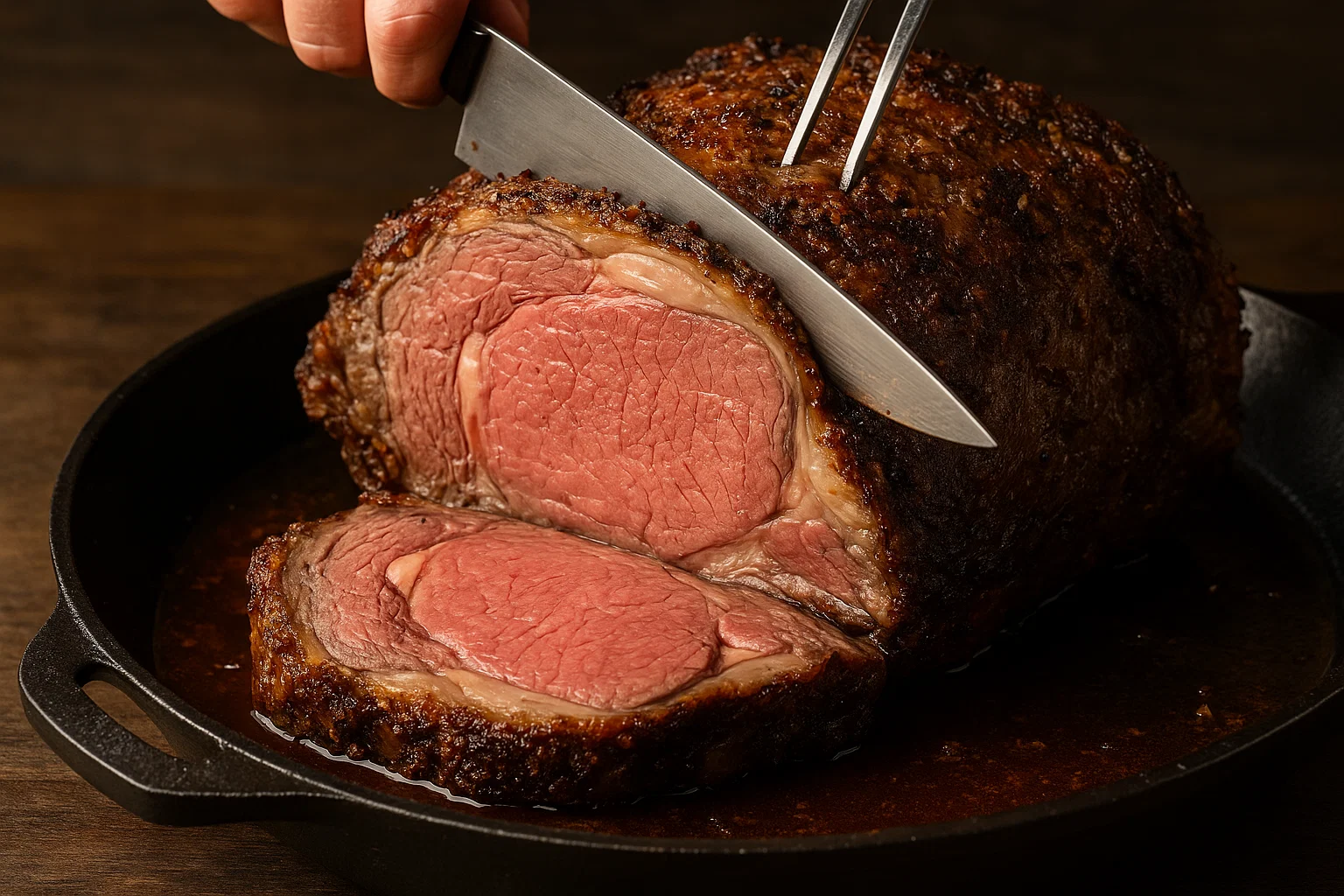
I prefer to slice the bones off first in one slab. I run my knife along the curve of the bones, separating the meat in one go. It makes carving the actual steaks much easier. Then, I slice the meat across the grain.
I remember the redemption dinner a year after my Christmas disaster. I used this reverse sear method. I was sweating as I made the first cut.
It was perfect.
A uniform, rosy pink from the crust to the center. The fat was rendered and translucent, not hard and white. I put the platter on the table, and the conversation just stopped. That silence? That is the highest compliment a cook can ever get. It means the food is too good to talk over.
What Sauce Should You Serve?
The meat should stand on its own, but we are building a feast here. You need the accouterments.
Au Jus: Liquid Gold
You have that roasting pan with the drippings. Don’t you dare throw that away. Place the pan directly over two burners on your stove. Add some red wine to deglaze, scraping up the brown bits (the fond) with a wooden spoon. Add good quality beef stock. Simmer it down until it reduces slightly. Strain it. That is your jus.
The Horseradish Factor
I need that sinus-clearing kick to cut through the richness of the fat. I whip heavy cream until it holds soft peaks, then I fold in prepared horseradish, a pinch of salt, and a squeeze of lemon juice. The cool, sharp, creamy sauce against the rich, hot beef is the perfect contrast. It wakes up your palate.
Storing and Reheating: Don’t Ruin the Leftovers
If you have leftovers (and that’s a big if with a crowd), treat them with respect.
Do not, under any circumstances, microwave prime rib. You will turn it into rubber shoe leather in thirty seconds.
Eat it cold. Seriously. A cold prime rib sandwich on good sourdough with mayo and a slice of cheddar is one of life’s great pleasures. Or, slice it thin and pour hot jus over it just to warm it through. If you must reheat a slab, do it in a low oven, covered, with a little beef broth to keep it humid.
A Note on Sourcing and Safety
When dealing with large cuts of meat and low cooking temperatures, food safety is always in the back of your mind. It is worth noting that according to the USDA Food Safety and Inspection Service, whole muscle cuts like roasts are sterile on the inside. This is why we can eat them rare, unlike ground beef which needs to be cooked through. The bacteria live on the surface, which we destroy with that final high-heat sear.
Final Thoughts on the Perfect Roast
Mastering the prime rib isn’t about magical talents or being a professional chef. It is about temperature management and patience.
It is about ignoring the urge to rush.
When you put that platter on the table, you aren’t just feeding people calories. You are creating a memory. The smell of the roasting beef, the clink of the wine glasses, the satisfaction of nailing the temperature—it all comes together in that one meal.
So, go to the butcher. Buy the roast. Dry brine it. Cook it low and slow. And when you ask yourself, “What is the best way to cook prime rib,” remember that the answer is simply: patience.
Fire up the oven. You’ve got this.
FAQs – What is The Best Way to Cook Prime Rib
What is the most effective method for cooking prime rib to ensure consistent edge-to-edge doneness?
The reverse sear method, which involves low-temperature roasting followed by a high-heat finish, is vastly superior for consistent doneness throughout the prime rib.
Why should I never rely on cooking time per pound when preparing a prime rib?
Cooking by internal temperature with a digital probe is essential because meat sizes and oven variances make time estimates unreliable, and only temperature ensures perfect doneness.
How does dry brining improve the quality of my prime rib?
Dry brining, which involves salting the meat a day in advance and refrigerating it uncovered, enhances juiciness by reabsorbing salt and moisture into the meat and creates a dry surface that sears better for a crispy crust.
What is the science behind the reverse sear technique?
The reverse sear allows enzymatic activity to tenderize the meat during slow cooking at low temperatures and ensures even heat penetration, resulting in pink, tender, and flavorful prime rib from edge to center.
Why is resting the meat crucial after cooking, and how long should I rest my prime rib?
Resting allows juices to redistribute within the meat, preventing dryness, and should be done for 30 to 60 minutes to let carryover cooking bring the internal temperature to the ideal level.