I’ll never forget the Sunday back in 2011 when I nearly choked my best friend. Not with my hands, but with a slice of beef. I’d invited the guys over for football, hyped up this “amazing brisket” I’d been working on, and dropped the platter on the table with way too much confidence. It looked okay. Smelled decent. But when he tried to stick a fork in it, the meat actually bent the fork tines. I had basically roasted a beef-flavored tire. I treated it like a pot roast—350°F for four hours—thinking I could rush the process. That disaster didn’t just ruin lunch; it started an obsession.
I spent the next few years ruining expensive cuts of meat, trying to figure out what I did wrong. Eventually, I realized you don’t need a massive offset smoker in the backyard or a beard full of hickory dust to get world-class results.
So, what is the best way to cook brisket if you don’t have a pitmaster’s setup? The answer is sitting in your kitchen right now. It’s your oven. But you have to use it differently. You have to mimic the low-and-slow patience of a barbecue pit. This guide is going to strip away the nonsense and show you exactly how to get that falling-apart, sticky, juicy meat without stepping outside.
More in Beef & Red Meat Category
What is The Best Way to Cook Filet Mignon
What is The Best Way to Cook Steak
Key Takeaways
- Patience is Everything: Your oven can act just like a smoker if you drop the temp to 225°F–250°F and refuse to rush.
- Don’t Fear the Stall: The meat temp is going to get stuck at 160°F for hours. It’s annoying, but it’s just science. Don’t touch the dial.
- Fat Caps Matter: You need to trim, but if you cut it all off, you’ll dry out the meat. Leave a quarter-inch layer to protect it during the long cook.
- Let It Sleep: Cutting into a hot brisket is a crime. You have to let it rest for at least an hour, or you’ll lose all the juice.
- Slice Smart: The grain direction changes halfway through the meat. If you don’t adjust your knife, you’ll be chewing on shoe leather.
Why Is Brisket Such a Pain to Cook Right?
Ever wonder why you can sear a steak in ten minutes, but a brisket takes twelve hours? It’s simple anatomy. The brisket muscle holds up the front of the cow. It’s doing heavy lifting all day long. Because it’s working so hard, it builds up a ton of tough connective tissue and collagen. If you blast it with heat like a steak, that collagen just tightens up. It wrings out the moisture like a wet towel, and you end up with dry, tough meat.
But here’s the cool part: if you give it time—lots of time—that tough collagen breaks down. It melts into gelatin. That gelatin is the secret sauce. It’s what gives real BBQ that sticky, succulent texture that coats your mouth. My early failures happened because I was cooking the meat, but I wasn’t melting the collagen. I was trying to sprint a marathon.
Which Cut Should You Grab at the Store?
The meat counter can be confusing. You’ve got different grades, sizes, and labels. Usually, you’re looking at two choices: the “packer” and the “flat.”
A full packer brisket is the whole shebang. It has two muscles stacking on top of each other: the skinny, lean “flat” and the fatty, thick “point.” This is what you want. The fat from the point renders down and basically bastes the flat while it cooks.
Sometimes you’ll see just the flat for sale. It’s smaller, sure, but it’s a trap for beginners. It has almost no internal fat, which means it dries out if you look at it wrong. I always tell people to buy the full packer. You get more room for error, better flavor, and the leftovers make the best chili you’ll ever eat. Try to find “Choice” or “Prime” if you can. Prime has more marbling (flecks of fat inside the meat), which acts like an insurance policy against drying it out.
How Do You Prep It Without Butchering It?
If you mess up the trim, you mess up the cook. Simple as that. A lot of guys think leaving all the fat on means more flavor. It doesn’t. In an oven, a thick, hard slab of fat just sits there. It won’t render. It’ll just be a greasy glob on the plate that your guests have to surgically remove.
You want the brisket to look aerodynamic. I take a sharp knife and shave the fat cap down to about a quarter of an inch. That’s the sweet spot—enough to protect the meat from the heat, but thin enough to melt into deliciousness. On the flip side (the meat side), get rid of the silver skin. It’s that thin, gray membrane. If you leave it, it turns into something resembling plastic wrap when it cooks.
I remember one time I got lazy and left a huge chunk of hard fat on the side of the point. It acted like a heat shield. The meat under it was raw, while the rest was done. Now, I trim aggressively. You want the heat to hit everything evenly.
Does the Rub Really Matter?
People overthink this. I used to spend twenty bucks on “Championship Rubs” that had coffee, sugar, paprika, and who knows what else. You know what happened? The sugar burned in the oven. It tasted bitter.
The best joints in Texas use two things: coarse Kosher salt and 16-mesh black pepper. That’s it. They call it the “Dalmatian Rub.” I mix it 50/50. The beef flavor is strong enough to stand on its own; it doesn’t need to hide behind chili powder.
Before I throw the rub on, I smear the meat with plain yellow mustard. Yeah, the cheap hotdog stuff. My brother-in-law looked at me like I’d lost my mind the first time he saw me painting a Prime brisket with mustard. But the flavor cooks out completely. It just acts as glue to hold that salt and pepper in place so you get a nice, heavy crust.
Can You Actually Get Smoke Flavor Indoors?
This is where the purists get mad. We’re cooking inside. We don’t have oak logs burning. But we can cheat a little.
I use liquid smoke. And not the cheap stuff—get a good quality hickory liquid smoke. Don’t drown the meat in it. I mix a little bit into the mustard binder, or I’ll mix it with some beef broth to mop the meat later. You just want a hint. It bridges the gap between “roast beef” and “barbecue.” If you use too much, it tastes like chemicals. Just a few dashes go a long way.
What’s the Setup for the Oven?
You can’t just toss the meat in a roasting pan and walk away. If the brisket sits on the bottom of the pan, it’s going to braise in its own juices. You’ll get pot roast. It’ll be tender, sure, but the bark will be mushy.
You need airflow. I grab a wire cooling rack and put it inside a rimmed baking sheet. The meat goes on the rack. This lets hot air circle all the way around the meat, cooking the bottom and top evenly.
Set the oven to 250°F. Some recipes say go lower, like 225°F, but home ovens are notorious for temperature swings. 250°F keeps you in the safe zone. I also put a separate pan of hot water on the bottom rack. It keeps the oven humid, which helps the smoke flavor stick (if you’re using it) and keeps the meat surface from turning into jerky before the inside is done.
The Cook: How Long Does This Really Take?
Here’s the frustrating answer: It takes as long as it takes. Every cow is different. You cook to texture, not time. But you need to plan your day, right? Figure on about 60 to 90 minutes per pound at 250°F. If you bought a 12-pound packer, you’re looking at a 12 to 14-hour commitment.
I usually start at 10:00 PM. Season it, oven on, meat in. Then I go to bed. Seriously. The oven holds steady temp way better than a charcoal grill. Waking up at 6:00 AM to the smell of rendering beef fat is better than any alarm clock I’ve ever owned. The dogs usually wake up before me, pacing around the kitchen.
What Is “The Stall” and Why Will You Panic?
Somewhere around four or five hours in, you’ll check the temp. It’ll say 160°F. Great, moving along. Two hours later, you check again. Still 160°F. You check the oven to make sure it’s on. It is. You start cursing.
Welcome to “The Stall.”
It’s just evaporation. The meat is sweating. The moisture cooling the surface is cancelling out the heat from the oven. It’s a standoff. My first time hitting the stall, I panicked and cranked the oven to 400°F. Ruined the meat. Dried it out instantly.
You have to trust the process. You can wait it out (which adds hours), or you can push through it with the “Texas Crutch.”
Should You Wrap It?
To beat the stall, we wrap the meat. This stops the evaporation, traps the heat, and forces the internal temp to climb again.
- Aluminum Foil: This is the easiest way. It creates a steam bath. You’re guaranteed juicy meat, and it finishes faster. The downside? The steam can soften that crusty “bark” you spent all night building.
- Butcher Paper: This is the cool, trendy way to do it. The paper breathes a little. It traps heat but lets some moisture out, so you keep a better crust.
Honestly? For the oven, I stick with foil. The oven is drier than a smoker. The foil ensures I don’t serve dry meat. I wrap it tight once the color looks like a dark mahogany and the temp is around 165°F.
How Do You Know When It’s Done?
Throw the clock away. The brisket is done when the thermometer reads somewhere between 200°F and 205°F. But don’t just trust the number. Trust your hand.
Take the probe of your thermometer and slide it into the thickest part of the flat. It should feel like you’re sliding it into a jar of room-temperature peanut butter. Zero resistance. If it feels tight or “catchy,” it needs more time.
Then there’s the “wobble.” Grab the pan and give it a shake. The whole piece of meat should jiggle like a bowl of Jell-O. That’s how you know the collagen has turned to gelatin. If it’s stiff, it’s not ready.
The Hardest Part: Resting
This is non-negotiable. If you cut into the brisket right when it comes out of the oven, you ruin it. I’m serious.
I made this mistake one Thanksgiving. Pulled it out, sliced it immediately. Steam poured out—it looked cool. But then a puddle of juice formed on the cutting board. Two minutes later, the meat was gray and dry as a bone. I had let all the pressure out before the juices could settle back into the meat.
Leave it wrapped in the foil. Wrap that whole bundle in an old towel, and shove it in a cooler (no ice, obviously). The insulation keeps it piping hot for hours. Let it sit for at least two hours. Four is even better. This wait is the difference between “okay” brisket and “life-changing” brisket.
How to Slice Without Looking Like an Amateur
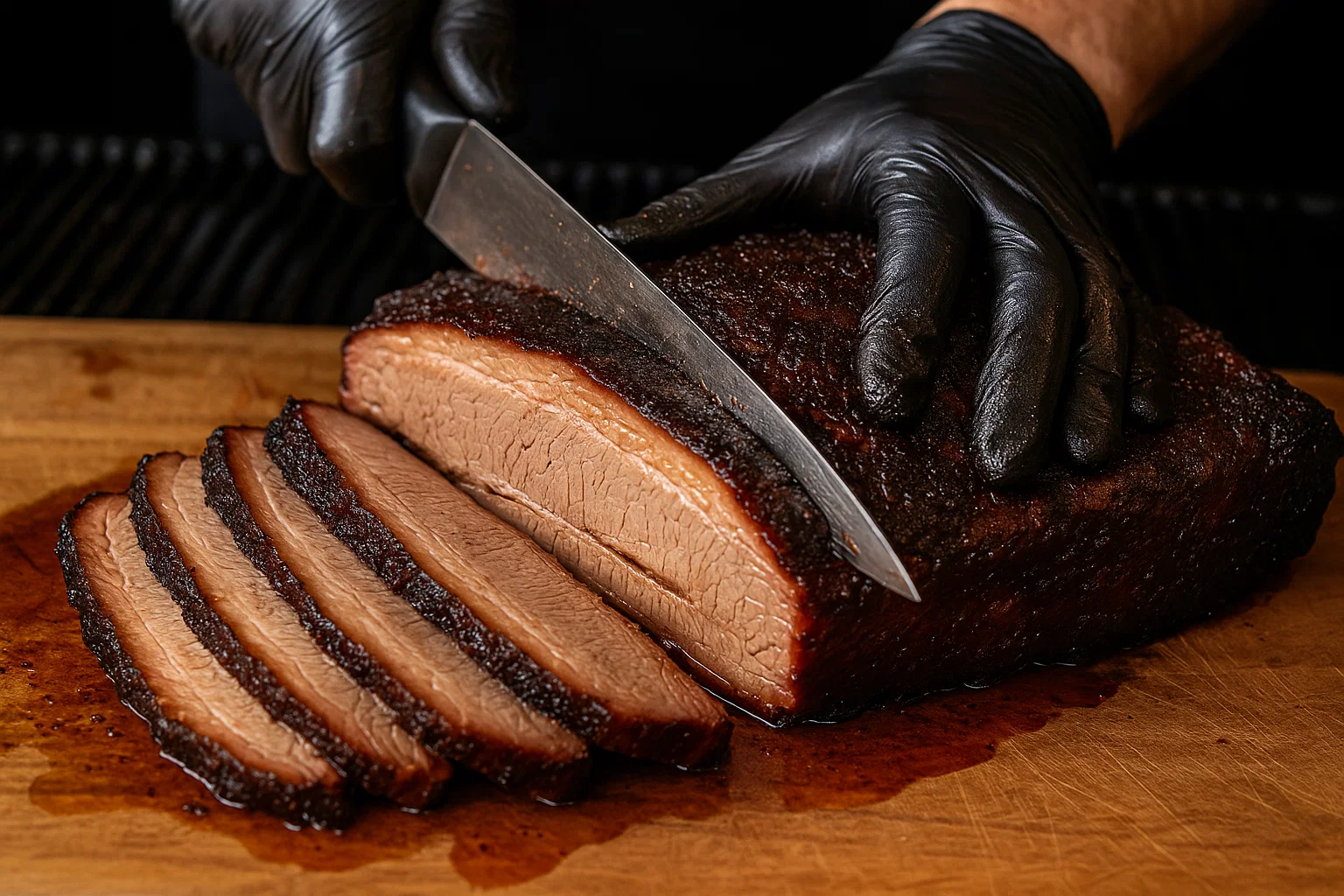
You’ve waited 14 hours. Don’t butcher the butchering. You have to slice against the grain. This cuts the muscle fibers short, making the bite tender.
Here’s the catch: The grain in the flat runs one way, and the grain in the point runs another. They overlap. I usually separate the point from the flat before I start slicing so I can see what I’m doing.
Slice the flat into strips about as thick as a pencil. Do the “pull test.” Pick up a slice. It should hold its own weight, but if you pull on the ends, it should tear apart easily. If it crumbles, it’s overcooked. If it snaps like a rubber band, it needed more time.
What To Do With Leftovers
Unless you’re feeding a linebacker squad, you’ll have meat left. This is a good problem. Brisket is almost better the next day.
I take the fatty point (if there’s any left) and cube it up. Toss those cubes in some BBQ sauce and throw them back in the oven until they get caramelized. Those are “Burnt Ends.” We call them meat candy.
The flat makes killer sandwiches, but my move is breakfast hash. Fry up some potatoes, onions, and peppers, then toss in chopped brisket until it gets crispy edges. Put a fried egg on top. It beats any restaurant brunch you’ll ever have.
Is It Safe?
I get asked this a lot. “Is it safe to cook meat that low?” Yeah, it is. According to the USDA Food Safety and Inspection Service, as long as the internal temp eventually gets high enough to kill the bacteria, you’re good. Since we’re taking this thing past 200°F, we are way past the danger zone. The long time at heat actually pasteurizes the meat.
Can You Really Beat a Restaurant?
Look, professional pitmasters have thousand-gallon smokers and decades of experience. But you have an advantage they don’t: You only have to cook one. You can pick the best slab of meat at the butcher. You can trim it with obsessive detail. You can rest it for four hours because you aren’t rushing to open for the lunch rush.
The first time I really nailed an oven brisket—got the bark, the texture, the flavor—I didn’t tell my guests how I cooked it. They assumed I’d been up all night feeding logs into a fire. I just smiled, took a sip of beer, and watched them go back for seconds.
Cooking brisket is a journey. You’ll probably dry one out. You might undercook one. But once you pull that perfect, wobbling slab of beef out of your own oven, you’ll realize the best way to cook brisket isn’t about fancy gear. It’s about patience.
So go buy the packer. Clear your weekend. Trust the heat. The best beef of your life is waiting in your kitchen.
FAQs – What is The Best Way to Cook Brisket
What is the best method to cook brisket without professional barbecue equipment?
The most effective method is using an oven set to 225°F–250°F, cooking the brisket low and slow to replicate barbecue pit conditions.
Why does brisket require such a lengthy cooking process, and what makes it challenging to cook properly?
Brisket is tough due to its abundant connective tissue and collagen, which need slow cooking to melt into gelatin, resulting in tender and juicy meat.
How should I prepare and trim the brisket before cooking?
Trim the fat cap to about a quarter-inch thickness, remove the silver skin, and avoid over-trimming to maintain moisture and promote even cooking.
What is the purpose of using simple seasonings like coarse salt and black pepper, and applying a thin layer of mustard?
These seasonings enhance flavor and help develop a crust without burning sugars, with mustard acting as a binder for the seasonings.
How can I manage the ‘stall’ during the cooking process?
Wrap the brisket in foil to trap steam and heat, which helps push the internal temperature past 160°F without drying out the meat.