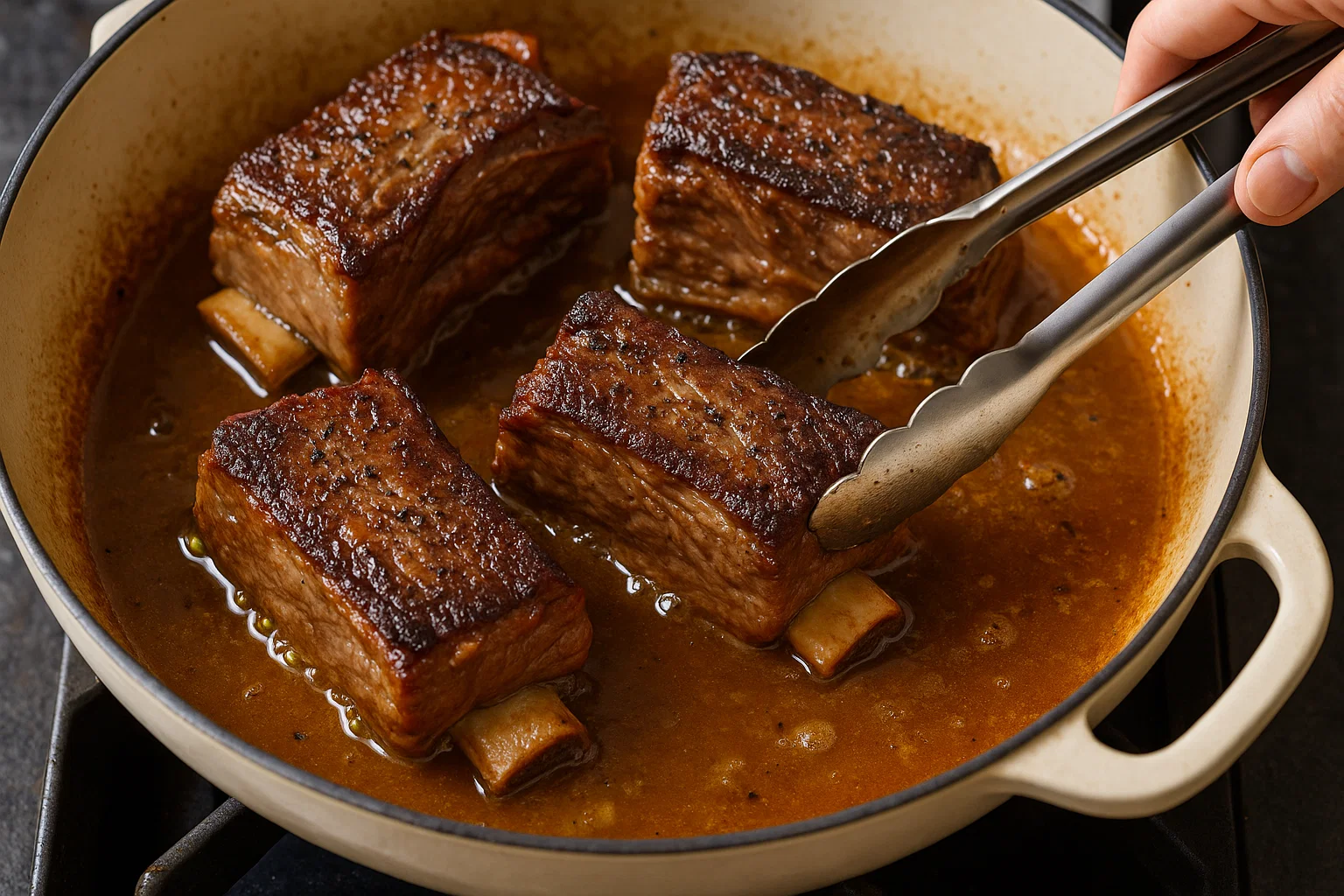
I still remember the first time I stared down a package of bone-in beef short ribs at my local butcher shop. They looked absolutely intimidating. We’re talking thick, brick-like blocks of meat attached to serious bone, marbled with enough white fat to make a cardiologist weep in public. I felt out of my depth. I asked the guy behind the counter—a burly fellow named Mike who always had flour on his apron and looked like he wrestled steers on his days off—”What do I even do with these?”
He leaned over the glass, lowered his voice like he was sharing a state secret that could get us both in trouble, and said, “You treat ’em like a bad date, kid. You give ’em wine, you give ’em heat, and you give ’em a lot of time to figure themselves out.”
He was right.
If you are standing in your kitchen right now, staring at a package of meat and wondering what is the best way to cook beef short ribs, let me save you the suspense: you braise them. You sear them until you think you’ve ruined them, drown them in red wine and aromatics, and let them cook until they surrender. But saying “just braise them” is like saying “just drive the car.” The magic isn’t in the recipe; it’s in the details. It’s in the fond stuck to the bottom of the pot, the specific choice of herbs, and the patience to let the collagen break down into gelatinous gold.
More in Beef & Red Meat Category
What is The Best Way to Cook Prime Rib
What is The Best Way to Cook Brisket
Key Takeaways
- Braising is Non-Negotiable: The combination of dry heat (searing) followed by low, moist heat is the only way to tame the tough connective tissue in this cut.
- The Sear Must Be Aggressive: You aren’t just browning the meat; you are building a foundation of flavor that will permeate the entire sauce.
- Bones Are Your Friends: Always choose bone-in over boneless for superior insulation during the cook and a richer, silkier mouthfeel in the sauce.
- Time is an Ingredient: You cannot rush this. If you try to speed it up, you get tough meat. If you let it ride, you get butter.
- Resting Improves Everything: Like a good stew, short ribs are infinitely better the next day after the flavors have married and the fat has settled.
Why Do Short Ribs Intimidate Even Experienced Home Cooks?
We need to talk about the anatomy of this cut before we even think about firing up the stove. Short ribs come from the “short plate” section of the cow. Think of them as the hardworking heavy lifters of the steer. They aren’t like a tenderloin that sits there looking pretty and doing absolutely nothing all day. These muscles work. They hold the animal up. Consequently, they are loaded—and I mean loaded—with collagen and connective tissue.
I learned this the hard way a few years back. I had an ego. I tried to treat short ribs like a ribeye. I threw them on a high-heat grill, thinking I’d get a nice medium-rare steak texture. Big mistake. Huge. I ended up with meat that had the consistency of a rubber boot. My guests were polite, sawing away at their plates and sweating, but I knew I had failed. That disaster taught me a valuable lesson: you cannot force this cut of meat to be something it isn’t.
You have to work with the structure of the meat, not against it. When you ask what is the best way to cook beef short ribs, you are really asking how to transform toughness into tenderness. The answer lies in the slow, chemical magic of breaking down collagen into gelatin.
English Cut vs. Flanken: Does the Cut Change the Plan?
You get to the store, and you see two very different things labeled “short ribs.” It’s confusing.
First, you have the “Flanken” style. These are cut across the bones. They look like long strips with three or four little circles of bone in them. This is what you see in Korean BBQ (Kalbi). They are delicious, but they are thin. They are meant for high heat and fast cooking. If you try to braise these for three hours, they will disintegrate into meat confetti.
Then you have the “English” cut. These are the big boys. They are cut parallel to the bone. You get one big chunk of bone with a thick block of meat sitting on top of it. This is what we want. This is the cut that can handle three hours in the oven without falling apart.
When you are buying them, look for marbling. You want specks of white fat distributed through the red meat. But be careful—you don’t want huge layers of hard surface fat. That won’t render out; it’ll just end up as a greasy slick in your pot. If the butcher hands you a piece that looks like it’s 50% fat cap, ask him to trim it or find another piece.
Does the Type of Pot Really Change the Outcome?
You might think any old pot will do, but I’m going to stop you right there. If you want braised joy, you need heavy artillery. My absolute favorite tool for this job is an enameled cast-iron Dutch oven. I have an old, chipped blue one that has seen more short ribs than I can count. It weighs a ton.
Why does it matter? Heat retention.
When you drop cold meat into a thin aluminum pan, the temperature plummets. The meat boils in its own juices instead of searing. A heavy Dutch oven holds its heat. It laughs in the face of a cold rib. It sears the meat aggressively, creating that Maillard reaction—the browning that equals flavor. Plus, the heavy lid traps moisture essential for the long haul.
If you don’t have a Dutch oven, can you use a slow cooker? Sure. A pressure cooker? Absolutely. But I find the oven method gives a reduction to the sauce that gadgets just can’t replicate. There is something primal about pulling a heavy pot out of the oven after three hours, the air thick with the smell of thyme and beef, that an Instant Pot beep just can’t match.
How Hard Should You Actually Sear the Meat?
Let’s get real about browning. Most people are too gentle. They are afraid of burning the meat or setting off the smoke alarm.
I’ll tell you a secret: if your smoke alarm doesn’t chirp at least once, you probably aren’t searing hard enough.
I like to salt my ribs at least an hour before cooking. I let them sit on the counter, coming up to room temperature. This is crucial. If you throw fridge-cold meat into hot oil, it seizes up. Then, I pat them dry. Bone-dry. Moisture is the enemy of the sear. If the meat is wet, it steams. If it’s dry, it sears.
When that meat hits the hot oil, I want to hear a violent hiss, not a gentle sizzle. I want a noise that sounds angry.
You want a crust that looks almost burned. A deep, mahogany brown on all sides. This isn’t just for looks. This is the foundation of your flavor profile. Those browned bits left on the bottom of the pot—the fond—are flavor bombs waiting to be detonated by a splash of wine. I once rushed this step because I was hungry and late starting dinner. The end result was fine, but the sauce lacked depth. It tasted one-dimensional. Never skip the hard sear. Do it in batches if you have to. If you crowd the pan, you are boiling, not searing.
What Vegetables Belong in the Braising Pool?
Once you remove the browned meat (setting it aside on a plate where I usually have to slap my own hand to stop from picking at the crispy edges), you have a pot full of hot fat and beefy essence. Do not waste this. This is liquid gold.
I stick to the holy trinity of mirepoix: onions, carrots, and celery. But here is the trick: chop them chunky.
If you mince them too fine, they turn to mush over a three-hour cook. They dissolve. I want pieces I can still identify later. I want a carrot that still looks like a carrot.
I toss them into the hot fat and let them sweat. I want the onions to pick up the color from the bottom of the pot. Then comes the garlic. I don’t crush it; I just smash the cloves and throw them in whole. Garlic burns fast, so I only give it a minute before the next step.
And here is my personal twist: tomato paste. I squeeze a healthy dollop right into the vegetables and stir it around. I don’t just add liquid immediately. I let the paste cook. I fry the tomato paste in the fat until it turns a rusty brick red. This caramelizes the sugars in the tomato and adds a savory umami backbone that makes people wonder, “What is that flavor?” It stops tasting like tomato and starts tasting like depth.
Is Red Wine Non-Negotiable?
This is a hill I am willing to die on. You need wine. specifically, you need a dry, full-bodied red wine. Cabernet Sauvignon, Merlot, or a Zinfandel work wonders.
Do not use “cooking wine” from the grocery store vinegar aisle. That stuff is loaded with salt and preservatives. It’s trash. If you wouldn’t drink a glass of it while you cook, don’t pour it over your ribs.
I remember a dinner party where I ran out of red wine and tried to substitute with a lighter Pinot Noir and some extra beef broth. It was… okay. But it lacked that dark, velvety richness that coats your tongue. The tannins in red wine help cut through the intense richness of the short rib fat. They balance the books, so to speak.
When you deglaze the pan with the wine, scrape the bottom with a wooden spoon like your life depends on it. Get every bit of that fond dissolved. Bring the wine to a boil and let it reduce by half. This concentrates the flavor and burns off the harsh alcohol bite, leaving behind only the fruit and acidity.
What is the Golden Ratio of Liquid to Meat?
This is where beginners often stumble. They hear “braise” and think “boil.” They drown the ribs completely in liquid.
Stop.
You are not making soup. You want the ribs partially submerged. I aim for the liquid to come about three-quarters of the way up the side of the meat. The tops of the ribs should peek out like little meat islands in a sea of red wine and stock.
Why does this matter? Because the exposed tops get roasted by the oven’s dry heat, developing a sticky, caramelized bark. The submerged parts gently stew, becoming tender. It’s the best of both worlds. If you cover them completely, you lose that texture contrast and end up with gray, sad-looking meat on top.
I use a high-quality beef stock to top off the pot after the wine reduction. If you make your own stock, I salute you; you are a better man than I. If you buy it, look for low-sodium options so you can control the salt level yourself. Store-bought stock can be incredibly salty, and as it reduces, that saltiness concentrates.
Herbs: Fresh or Dried?
Fresh herbs make a difference here. I tie a bundle of thyme, rosemary, and a bay leaf together with kitchen twine. I call it the “flavor broom.” I toss it right into the liquid.
Dried herbs can work in a pinch, but fresh thyme has a floral, earthy quality that dried thyme loses. Plus, fishing out a bundle of stems is much easier than trying to skim dried flakes off your finished sauce. No one wants a mouthful of dried rosemary needles.
I also throw in a strip of orange peel sometimes. Just a small piece. It sounds weird, but the subtle citrus oil brightens up the heavy, fatty dish. It’s a trick I picked up from a cookbook dedicated to Italian stews, and it adds a layer of complexity that keeps the dish from feeling too heavy. Just don’t include the white pith, or it gets bitter.
Low and Slow: What is the Magic Number?
We’ve seared, we’ve sautéed, we’ve deglazed. Now comes the hardest part: waiting.
I slide the heavy pot, lid on tight, into a 325°F (163°C) oven.
How long? Two and a half to three hours. Maybe three and a half. Short ribs are done when they say they are done. You can’t stick a thermometer in and pull them at a specific number like a steak. Temperature doesn’t tell you if the collagen has melted.
You test for doneness with a fork. You should be able to slide a fork into the meat and pull it out with zero resistance. It should feel like sticking a fork into a jar of peanut butter. If the meat grabs the fork, it needs more time. Put the lid back on and walk away for another thirty minutes.
I once pulled a batch too early because my guests arrived and I was panicking. The meat was cooked, sure, but it was tough. The collagen hadn’t fully melted. We ate it, but it was a jaw workout. I kicked myself for days. Now, I start cooking way earlier than I think I need to. Ribs can always rest. They actually taste better if they sit for a while.
How Do You Handle the Fat?
Short ribs release a lot of fat. It’s just the nature of the beast. After three hours, you will likely see a slick of oil floating on top of your beautiful sauce.
You have two choices here.
If you are serving immediately, tilt the pot and use a ladle to skim off the top layer of grease. It takes a steady hand, but it’s necessary. You want the sauce to be rich, not greasy. A trick is to drag a slice of white bread across the surface; it soaks up the oil like a sponge.
The better option? Cook these the day before. I’m serious. Let the pot cool down, then stick the whole thing in the fridge overnight. The next day, the fat will have solidified into a white puck on top. You can just lift it off with a spoon.
Plus, braised meats always taste better the next day. The flavors have time to marry and get to know each other. It takes the stress out of hosting, too. You just gently reheat the pot on the stove while you drink wine with your friends.
What Should You Serve Alongside This Masterpiece?
You have created this intense, savory, rich meat dish. You need a side that can stand up to it.
My go-to is creamy polenta. The corn flavor pairs beautifully with the beef, and the soft texture acts as the perfect mop for that wine sauce. Mashed potatoes are a classic runner-up. You want something starchy and creamy.
I usually roast some simple vegetables, like asparagus or Brussels sprouts, to add some green and a bit of crunch. You need that textural contrast.
I remember serving this over egg noodles once, stroganoff style. My kids loved it. It was messy, glorious comfort food. But for a dinner party, a mound of parmesan-spiked polenta with a short rib perched on top looks restaurant-quality.
Is the Instant Pot Ever the Better Choice?
Look, I love my pressure cooker. For a Tuesday night when I get home at 6 PM? Absolutely. You can get tender short ribs in about 45 minutes under pressure.
But (and it’s a big but) you sacrifice the reduction. The pressure cooker traps all the moisture. You end up with a thinner sauce. If I use the pressure cooker, I always remove the meat at the end and boil the heck out of the sauce using the “Sauté” function to thicken it up.
So, when answering “what is the best way to cook beef short ribs,” the oven wins on flavor, but the pressure cooker wins on convenience. It depends on what kind of “best” you need today.
Can You Overcook Short Ribs?
Believe it or not, yes.
There is a myth that you can’t overcook braised meat. That’s false. If you leave them in the oven for five or six hours, the meat structure completely collapses. It turns into mush.
You want the meat to be tender, but you still want it to look like a piece of meat, not baby food. There is a sweet spot where the meat holds onto the bone but slides off with a nudge. That is the texture we are chasing. Keep checking them after the 2.5-hour mark.
What About the Leftovers?
If you are lucky enough to have leftovers, you have struck gold. Shred the meat and toss it with pasta. Make the world’s most decadent grilled cheese sandwich. Or, my personal favorite, short rib tacos.
A little lime juice and cilantro on a taco cuts through the richness of the leftover beef perfectly. It feels like a completely different meal. I almost always buy two extra pounds of ribs just so I can make tacos the next day. It’s a gift to my future self.
Why is Bone-In Better Than Boneless?
You will see boneless short ribs at the store. They are easier to eat, sure. But the bone provides insulation. It keeps the meat near it from overcooking.
More importantly, the bone releases marrow and minerals into the sauce as it cooks. It adds a stickiness, a body to the sauce that you just don’t get with boneless cuts. The “mouthfeel” (a fancy chef word for texture) is superior with bone-in.
If you have to use boneless, check them earlier. They cook faster and dry out faster.
Troubleshooting: What if My Sauce is Too Thin?
This happens. You open the pot and it looks like soup. Don’t panic.
Remove the meat and vegetables carefully. Put the pot on the stove over medium-high heat. Let it boil.
You can create a “slurry” with a teaspoon of cornstarch and a splash of cold water, then whisk it into the boiling sauce. It will thicken instantly. Or, just let it reduce naturally. I prefer the natural reduction because it concentrates the flavor, whereas cornstarch just thickens the texture.
For more information on the science of meat and food safety, you can refer to the USDA Food Safety and Inspection Service.
A Final Thought on the Process
Cooking short ribs isn’t just about feeding yourself. It’s a ritual. It’s about taking a tough, stubborn ingredient and transforming it through patience and care.
There was a winter a few years ago where the power went out during a snowstorm. I had a gas stove and these ribs in the Dutch oven. The house was getting cold, but the kitchen was warm. We ate those ribs by candlelight, tearing the meat off the bone, wiping sauce off our chins with crusty bread. It was one of the best meals of my life.
So, buy the wine. Sear the meat until you’re scared you burned it. Let the house fill with that intoxicating aroma. The best way to cook beef short ribs is with braised joy, a heavy pot, and nowhere to be for a few hours.
FAQs – What is The Best Way to Cook Beef Short Ribs
Why do short ribs require slow cooking and braising?
Short ribs are a tough cut loaded with collagen and connective tissue, so they need slow, moist heat to break down these tissues into tender, flavorful meat.
Does the cut of short ribs (English vs. Flanken) affect cooking method?
Yes, Flanken cut is thin and best suited for high heat and fast cooking, while English cut is thicker and ideal for slow braising, capable of withstanding several hours in the oven.
Why is a heavy cast-iron Dutch oven recommended for braising short ribs?
A heavy cast-iron Dutch oven retains heat better, sears the meat effectively, and traps moisture with its lid to ensure even cooking and flavor development.
Can you overcook short ribs, and how do you know when they are done?
Yes, overcooking is possible if the meat collapses into mush. Short ribs are done when a fork slides in easily and the meat is tender yet still holds some structure, typically after 2.5 to 3 hours in the oven.